4×18: Chuck the Prophet

When Chuck is finally convinced that Sam and Dean are really his characters, he begins to explore the implications:
CHUCK: Well, there’s only one explanation. Obviously, I’m a god.
SAM: You’re not a god.
CHUCK: How else do you explain it? I write things and they come to life. Yeah, no, I’m definitely a god. A cruel, cruel, capricious god. The things I put you through—the physical beatings alone. […] All for what? All for the sake of literary symmetry. I toyed with your lives, your emotions, for entertainment.
DEAN: You didn’t toy with us, Chuck, okay? You didn’t create us. […] Chuck, you’re not a god!
SAM: We think you’re probably just psychic.
CHUCK: No, if I were psychic, you think I’d be writing? Writing is hard.
SAM: It seems that somehow you’re just focused on our lives.
DEAN: Yeah, like laser focused. Are you working on anything right now?
CHUCK: Holy crap.
DEAN: What?
CHUCK: The, uh, latest book, it’s uh, it’s kind of weird. […] I wrote myself into it. I wrote myself, at my house, confronted by my characters.
This encounter provokes many questions about how Chuck’s authorship even works. All we know at the start of the episode is that Chuck has visions, and his books are “accurate” accounts of what we’ve seen so far. What Chuck determines here is that that must mean that he is “a god,” that he created the characters and that whatever he writes comes true because he writes it. In other words, through writing, Chuck has creative power and control over the narrative, the characters and their actions. However, Sam and Dean insist here that that cannot be the case, that he merely has sight—he can see their lives as they happen and will happen and transcribe those visions onto the page. Therefore, the act of writing is not an act of creation but rather transcription, the characters still in control of their own actions. In other words, for them, the story precedes the text, even when the text includes things that have not occurred yet.
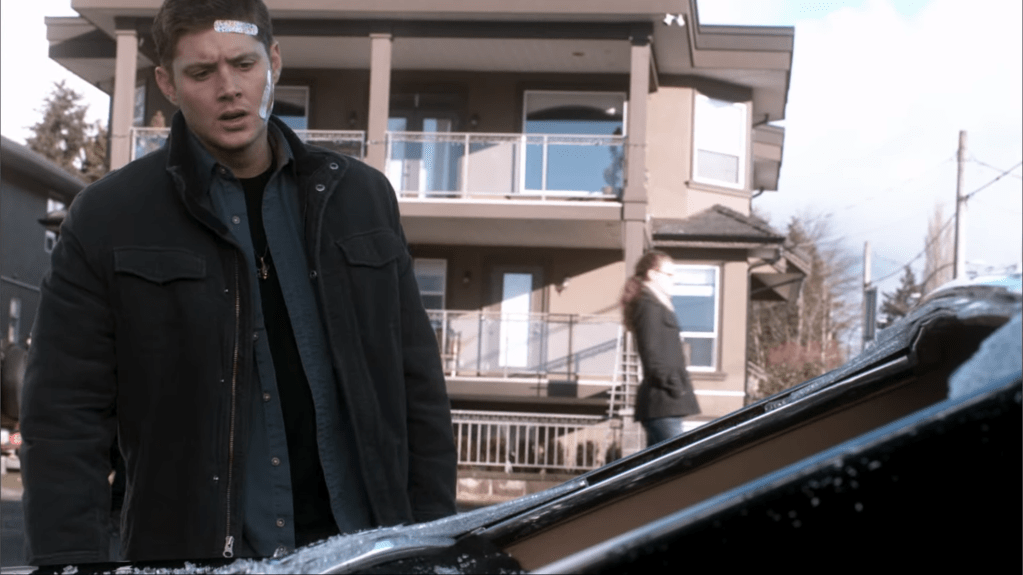
This dilemma, as yet unresolved, leads the brothers to consider what they ought to do with the information they’ve received. In particular, Chuck has a vision of Sam meeting and having sex with the demon Lilith at the Red Motel. Sam is skeptical of Chuck’s visions because he imagines he would never give in to Lilith’s whims, and plus, even the little details of the story seem particularly far-fetched: for instance, it recounts Dean having pink band-aids on his face and driving around with a tarp on the Impala’s back window, things he would never do. Therefore, Sam argues that they should use the chapter to find Lilith and kill her. Dean, proclaiming that Sam is not ready to face her, thinks they should get out of town, and when that doesn’t work (the only route out of town is, of course, blocked), he argues they should use the chapter as a guide for what not to do. But despite their best efforts, things go exactly as written, down to the pink band-aids.
The apparent inescapability of Chuck’s narrative, evidenced by the improbable events that befall the brothers in their efforts to avoid it, suggests that the apparent free will the brothers claim to have is an illusion and that, even since (at least) the show’s first episode, they have been acting according to God’s plan for them, expressed through Chuck’s prophetic visions and published in the Supernatural books.
Yet at the same time, the ways that Chuck’s visions appear to him, and the way he puts them down on the page, call that conclusion into question. Firstly, Chuck’s visions are depicted in the show as flashes of future events, delivered through Chuck’s nightmares. For Chuck, though, these are relatively coherent events, or at least clear enough for him to write into a coherent narrative. As we saw above, even the most innocuous details he writes come true, but not necessarily in the way they were written. For example, the chapter reads that Dean will eat a bacon cheeseburger, so Dean attempts to avoid that by ordering the veggie tofu burger. However, he receives the wrong order, eating a bacon cheeseburger despite his best efforts. If what Chuck had written were accurate to what would happen, Dean would have known that he tried to order a veggie tofu burger and gotten a bacon cheeseburger instead, but the chapter did not include that detail. Therefore, one can conclude either that Chuck’s prescience still leaves room for alternative action, even if that action has the same end result, or that Chuck left certain details out of his account.
If the latter is true, then we must ask why Chuck would leave these details out. Regarding the cheeseburger detail, it’s not farfetched to assume that Chuck did not see it as important, that it only becomes important to us (the audience) in the frame of the episode’s own narrative (shaped by the show’s writers). If Chuck’s visions take the shape of “raw” events with no narrative framing, then it is up to him as the prophet to add that framing. However, as a prophet, he might be understood as receiving a “pre-framed” narrative, only certain events shown that are already ordered and framed into a narrative. In this latter conceptualization, Chuck’s role as a prophet is less as an original author, taking a big (omniscient?) picture of the event and focusing and framing it into a coherent narrative, and more as a translator, receiving an already-composed narrative (a vision from God) and converting it into a new medium (a written book).
But even as a translator, Chuck exercises certain power over the narrative he constructs. For example, he tells Sam that he knows about the demon blood but that he left it out of the books because he thought it might make Sam “look unsympathetic.” Additionally, he conceals that he already knew he was a prophet, claiming that he didn’t write that into the story because that would have been “M. Night-level douchiness.” We might think of these obfuscations on Chuck’s part as referring to the ways authorship in general involves selective exclusion of details, whether they be insignificant or important to the overall plot. But we should also ask why, even after Chuck knows he is a real character in the story whose visions, down to the last detail, could help the Winchesters save the world, he still leaves things out.
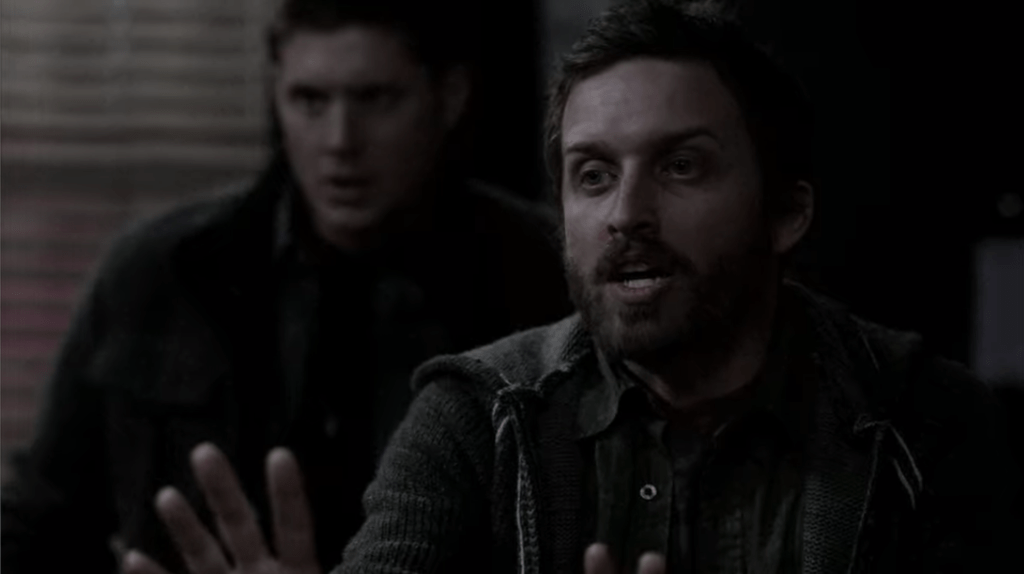
We turn, then, to the former possibility—that Chuck’s prescience is flexible, and there is room for certain levels of free will. If that is the case, then Chuck’s position as a prophet should be seen as more limited than originally thought—what he sees come to pass may not be certain, even if it is nonetheless difficult to change. We see this tension in the episode when Cas insists that “what the prophet has written can’t be unwritten,” and Dean resists the idea that they are “just supposed to sit around and wait for it to happen.” Cas, who claims he cannot interfere with a prophecy nonetheless gives Dean an idea: to use the archangel assigned to Chuck to kill Lilith.
When Dean goes to retrieve him, Chuck claims that he didn’t see Dean coming or himself joining the fight, but Dean insists that “This isn’t a story anymore, man. This is real! And you’re in it! Now I need you to get off your ass and fight.” In this turn of events, it seems that Cas and Dean have found a loophole, a narrative route that Chuck did not predict. Notably, this occurs in a moment where Chuck’s position as seer-author becomes blurred with his position as full-blown character in the action. And it seems that by going down this alternate path, and succeeding in saving Sam, free will has prevailed, and Chuck’s visions may not be entirely set in stone.
How do these nuances in Chuck’s position as prophet (meta)refer to the show as show?
 The God Author